


Your Next Customer Is a Robot. And It Just Wiped $500 Billion Off Google.
The worst day in Google's life
On Thursday, Alphabet had the worst trading day in its 22 years as a public company. Shares fell about 13% and close to US$500 billion of market value went with them, the second-largest one-day wipeout of any US-listed stock after Nvidia's DeepSeek moment in January 2025 (Yahoo Finance).
Search revenue came in at roughly $63 billion, up 12% on last year. Most companies would celebrate that with a long lunch. Wall Street wanted $65 billion, and a $2 billion miss on a business that size is a rounding error. Investors sold anyway, because they read it as the first quarter where AI started taking real money out of Google's pocket.
My colleague Tony Novia sent the Bloomberg story around our office with the subject line "The chatbots are coming for Google." He's right. I think the headline is also a year late. Chatbots came for the search box in 2024. The thing arriving now is software that skips the search box and goes straight to the checkout, with your card details.
That changes who the customer is. For 25 years every business on earth has been designed around a human with a browser. The next customer you serve may have no eyes and zero interest in your banner ad.
Agentic buying, explained to my mum
Your car insurance renewal arrives. The premium has gone up again. You know you should shop around, so you open six tabs, type your date of birth and rego into six forms, get called by two brokers, lose the will to live and pay the renewal.
Now imagine you send one text: "My car insurance renews on the 14th. Find me the same cover for less." Twenty minutes later you get three quotes back, ranked, with the catches highlighted. You reply "the second one" and it's done. That's an AI agent. It's a piece of software that has your preferences, your budget and permission to act, and it does the clicking and paying for you.
On the selling side, the insurer runs its own agent, one that can answer questions and, if it's smart, adjust the price to win your business while your agent is still deciding. Two robots, one on each side of the counter, negotiating in seconds. The human sets the brief and approves the result.
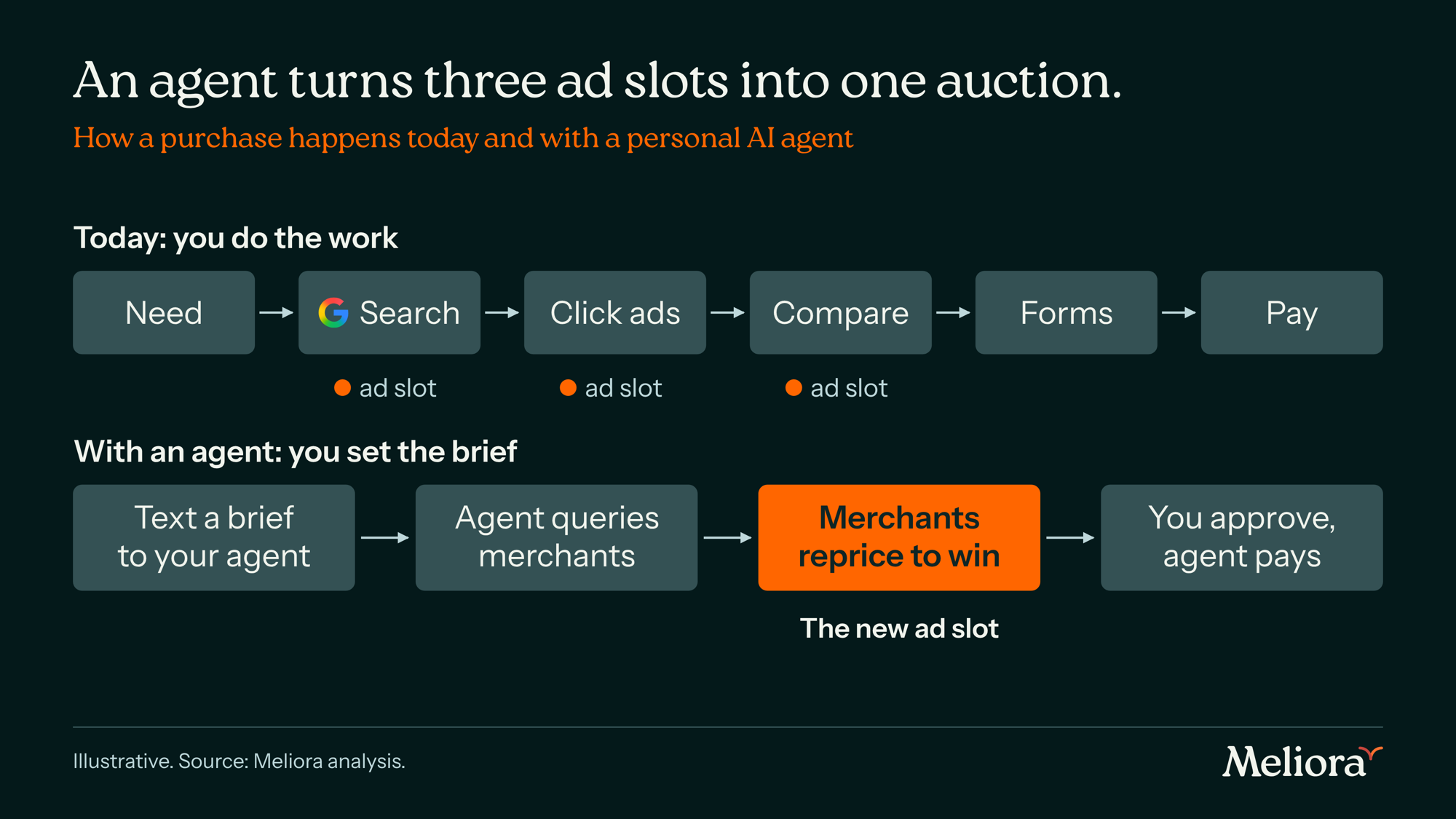
Today's journey gives an advertiser several chances to interrupt a human. The agent journey gives one: the moment merchants compete for the brief, on price, terms and data quality as much as media spend.
That's agentic commerce. Everything below is what happens to the economy of the internet when it scales.
What I told Tony
Tony's email landed at 10:57 on Friday morning. I replied from my phone about half an hour later, which is usually when my best and worst ideas get sent. Here's the core of it, unedited:
Google are likely going to launch their own agent solution imminently I suspect. They already have so many interlaced users in their environment esp with the penetration of Gmail, Android and Google workplace, even dare I say browsing history via Chrome. Each user's data repositories are effectively an out of the box harness for an agent... And if they're really smart they should build concurrently an AEO capability for brands via Google Ads to be considered/prioritised for agents to discover. If I'm using an agent to get me a better rate on car insurance an insurer should be able to dynamically price to increase competition and drive conversion. It's the new two-sided marketplace.
One footnote to my own email: "context" is a more precise word than "harness", and antitrust and privacy rules limit how freely Google can pool that data, Chrome history above all.
I stand by all of it, and on reflection I'd go further. Google's real problem on Thursday was strategic. It owns the best agent harness on the planet: your inbox, your calendar, your location history, your Android phone and your Chrome tabs. And it's watching Meta, OpenAI and a startup that communicates by SMS build the agents first.
Meta knows you. Google understands you.
Meta knows who your friends are and what you like. Google knows what you wanted to find out. It has every question you've ever typed into a search bar: the late-night fact-check to settle an argument with your mates, the symptoms you ran past Dr Google at 2am, the how-to video you watched before taking a drill to the bathroom wall. An agent runs on intent, and nobody holds more of it.
AEO, answer engine optimisation, is the discipline of making your brand legible and preferable to a machine. Whoever builds the auction for that, the place where an insurer pays or reprices to be the option an agent recommends, owns the next version of the ad business. Google built the last one. The keyword was the unit of intent. In the agent economy, the unit is the brief.
The numbers are moving faster than the narrative
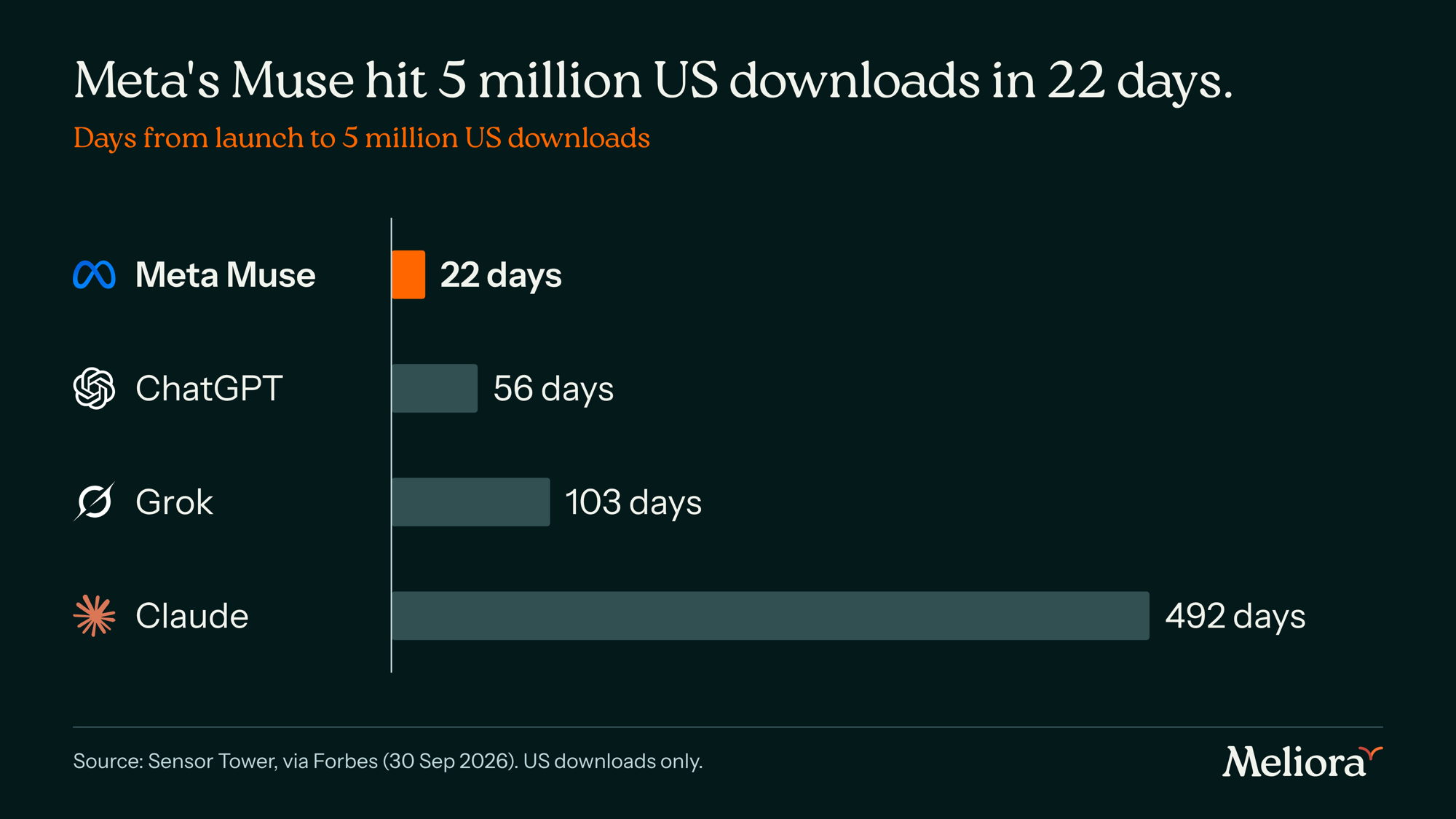
Meta launched Muse, its personal agent, on 8 September. It can open a browser, fill in forms and buy things for you, and it passed 5 million US downloads in 22 days (Forbes). ChatGPT took 56. Meta did put up to half its daily house ad inventory behind it, so this is part product and part distribution muscle. Both count.
If you want to know who's really shopping online, ask the people paid to keep robots out. Bot management firm DataDome counted about 25 billion AI agent requests to the sites it protects in Q3 2026, up 41.5% on Q2, and agentic browser traffic grew 4.7x in September alone. In one week in October, Muse made 22.1 million requests across those sites (DataDome).
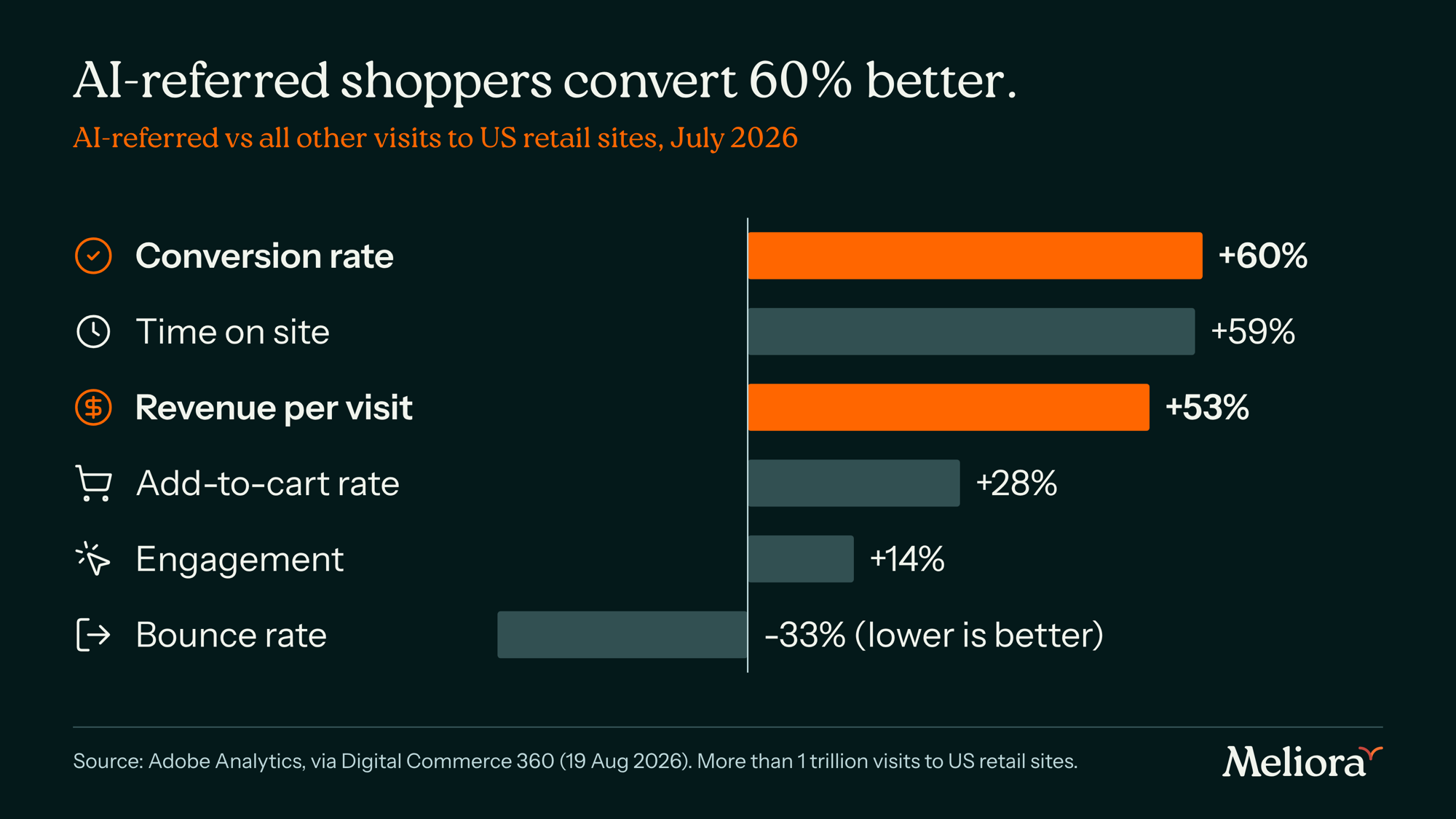
Bad news for anyone selling impressions: the shopper an AI sends you is a better customer than the one who wandered in. Adobe tracks more than a trillion visits to US retail sites. AI-referred traffic was up 62% year on year in July and up 1,219% since October 2024. Those visitors beat everyone else on every engagement measure Adobe tracks (Digital Commerce 360). A shopper who arrives via an AI has usually made up their mind.
Venture capital, never knowingly late to a party it can see from space, has turned up with a cheque. Instinct, an agent you talk to over text message, launched invite-only in August and raised US$1 billion at a $10 billion valuation in September, a month after a round at $2.5 billion (TechCrunch). It quadrupled its value in about four weeks without publishing a single user number.
On the same day Alphabet lost half a trillion dollars, Wabi raised US$55 million at a $1.25 billion valuation (TechCrunch). Wabi is the latest company from Replika founder Eugenia Kuyda, and it rebranded as a "personal agent" in September. Ask it to plan a week of meals or a date night and it builds you a small app to do the job. IVP led the round, and the angels include Shopify's Tobi Lütke and Salesforce's Marc Benioff. When the man who runs millions of online stores writes a personal cheque into the agent layer, retailers should ask what he knows.
So how does a free agent pay for a $10 billion valuation? Barely through you. Muse is free at the entry tier and Dots comes bundled into ChatGPT plans people already pay for. Instinct hasn't said how it will charge at all. The money is being raised on the other side of the counter, using business models that didn't exist two years ago.
The most obvious is the commission. Meta plans to take a small affiliate cut whenever Muse completes a purchase or a booking (Forbes). Your agent is quietly on retainer from every merchant it sends business to. Zuckerberg has gone a step further and floated a fee on merchants whenever Muse helps someone buy, sell or save (Digiday). Google charged for the click. Meta wants to charge for the sale.
Then there are ads inside the answer, which ChatGPT has turned into a billion-dollar run rate in about six months (more on that below), and sponsored conversations, which Amazon launches in January. And the strangest model of all is machines paying machines. Mastercard's Agent Pay runs on x402, a protocol that lets an agent pay a few cents for a single piece of data or one API call, with Fortune's examples running from 27 cents to $1.87 (Fortune). The web's original business model was "free, plus ads." The agent web's is "free, plus a cut of everything."
The oldest asset in the room is still attention, now with better data attached. Each brief a person types into an agent is a statement of intent with a budget and a deadline. Meta says Muse conversations are kept away from its ad systems. That promise is about to become one of the most valuable, and most tested, in tech.
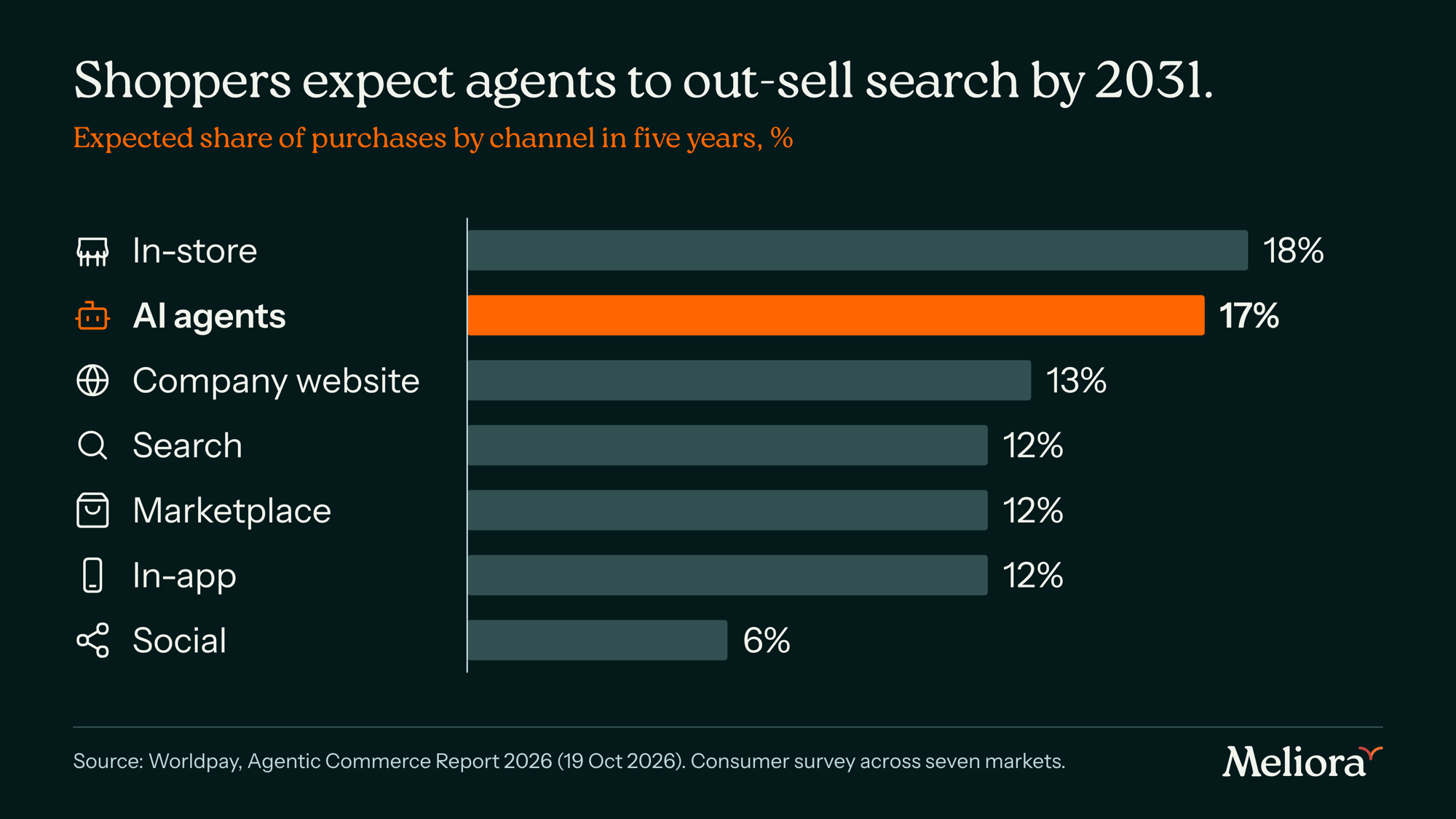
Ask people how they'll shop in 2031 and they rank the robot ahead of the search bar. Worldpay's 2026 survey across seven markets found 58% of consumers expect to buy something through an AI agent. Asked to project five years out, they put agents one point behind physical stores and ahead of both company websites and search (Worldpay). Read that again if you sell search ads.
Before anyone fires their media agency, some cold water. In a Gartner survey from January, only 11% of US consumers would let AI make the final purchase decision, even for toothpaste and dishwashing liquid (Gartner). People want the agent to do the legwork and they want to keep the last click. For now.
Ten jobs people are hiring agents for
The first wave of agent use cases shares one trait. They're the chores people hate, where the saving is real and the emotional attachment to the brand is close to zero. Nobody has a favourite electricity retailer.
# | Use case | What the agent does | Evidence |
|---|---|---|---|
1 | Price comparison and deal hunting | Checks every seller for the same item and flags the best total price | 61% of consumers who have shopped with AI use it to compare prices (Worldpay) |
2 | Product research and shortlisting | Reads specs and reviews, returns a ranked shortlist | 56% use AI to research a product (Worldpay) |
3 | Personalised recommendations | Matches products to stated needs, budget and history | 52% use AI for a personalised recommendation (Worldpay) |
4 | Insurance, energy and telco switching | Gathers quotes at renewal, compares like-for-like cover, switches | Best price is the top purchase motivator, cited by 69% (Worldpay) |
5 | Bills and subscription cancellation | Pays bills on time, finds and cancels unused subscriptions | Core Instinct features (TechCrunch) |
6 | Travel booking | Searches flights and hotels within a budget and books them | Offered by both Instinct and Muse (Forbes) |
7 | Restaurant bookings and appointments | Books tables, phones businesses to make appointments | Instinct's concierge makes phone calls; Muse connects to OpenTable (The New Stack) |
8 | Groceries and household restocking | Reorders staples, swaps out-of-stock items | 31% would let AI narrow choices on household supplies (Gartner) |
9 | Government fees and fines | Pays parking tickets and public-service fees | Supported by Mastercard Agent Pay (Fortune) |
10 | Business procurement and invoices | Raises purchase orders, processes invoices, handles contracts | OpenAI tested its enterprise Dots on these tasks (The Next Web) |
Rows one to three are where consumers are today. Rows four to ten are where the money is, because they involve recurring spend and a customer who would happily never think about it again.
Expert mode: Muse, Instinct, Dots and the plumbing underneath
Three personal agents launched within eight weeks of each other this year, and each one took a different route to your wallet.
Agent | Maker | Launched | How you engage with it | How it reaches a merchant | How it makes money |
|---|---|---|---|---|---|
Meta | 8 Sep 2026 | App, inside Meta's social apps | Drives a normal browser session; native connectors for partners such as Gmail and OpenTable; Shop Pay checkout across Shopify stores | Free tier, $20 and $100 monthly plans; affiliate cuts on purchases and bookings | |
Instinct (founder Noah Shinn) | Aug 2026, invite-only | SMS, from its own phone number | Its own computer and residential proxies; also makes phone calls | Not disclosed; US$10b valuation | |
OpenAI | 29 Sep 2026 (DevDay) | ChatGPT, Slack, Teams; text coming | A cloud computer and Chrome browser per agent; 4,000+ app plugins | Bundled into Pro and Business Premium; sits beside ChatGPT ads, now at a $1b run rate |
Muse, Dots and Instinct all fall back on operating a website the way a person would. That's a hack. It works because the web was built for humans and nobody asked permission, and it's why DataDome could watch all three of them buy the same US$149.99 keyboard and identify each one in the logs (DataDome).
The hack has already triggered the first border war. Amazon started blocking Muse from Amazon.com on 20 September, twelve days after launch, arguing that Meta never told it Muse was coming, that Muse doesn't identify itself and that it appeared to store customer credentials (The New Stack). Shopify went the other way. The day after the block it announced agentic checkout with Meta, where Muse reads structured product data and pays with a single-use Shop Pay credential. Same agent, opposite strategies. Amazon is betting it can keep the customer relationship by keeping the robots out. Shopify is betting its merchants want the robots' money.
Three efforts are under way to replace the browser hack with structured access:
- Google's Universal Commerce Protocol, announced at NRF in January with Shopify, Etsy, Wayfair, Target and Walmart, gives agents one common language for catalogues, carts and payments, and plugs into Google Pay inside AI Mode and Gemini.
- The Personal Agent Protocol, from Meta and Sierra with Instinct, Shopify, Stripe and Walmart on board, launched on 6 October. It lets a business decide what a personal agent can see and do, and know when one is acting for a customer.
- Mastercard's Agent Pay, built on the open x402 standard, lets personal agents pay retailers and even settle parking fines. Its head of product, Jorn Lambert, calls this moment "a bit of a turning point" (Fortune).
Under those sit MCP, the standard for connecting agents to tools, and OpenAI's ACP for checkout. A year ago people expected those two to carry adoption. What carried it was consumer agents with a big ad budget behind them, and the protocols are now racing to catch up with the traffic.
Put it together and the stack has four layers. A personal agent holds the user's intent and context. A protocol layer decides what it may see and do. A payments layer lets it spend with limits. And on the merchant side, a selling agent answers, prices and closes. Whoever controls the first layer gets the leverage over the other three. That's why Meta gave Muse up to half of its daily house ad inventory.
What it means for you, the human
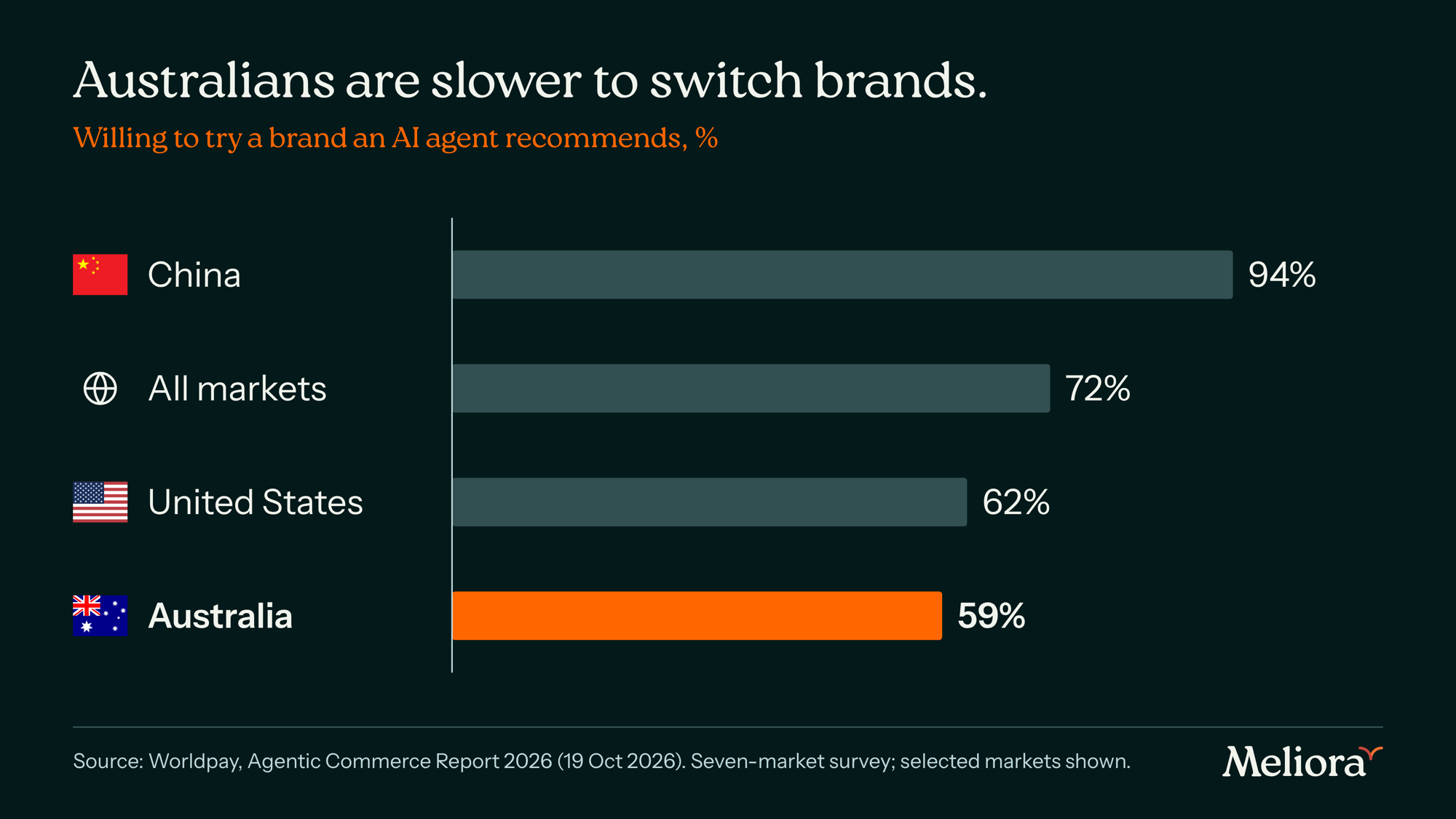
The loyalty tax is about to get much harder to collect. A lot of consumer businesses, insurance and energy in particular, make a disproportionate share of their margin from customers who can't be bothered to switch. An agent can always be bothered. Price is the top reason people use one, cited by 69% in Worldpay's survey, and 72% say they'd try a different brand if their agent recommended it (Worldpay). Australians are well below the average, which tracks for a nation that still reads the fine print on a meat pie.
Few people ask at sign-up who the agent works for. Muse is free at the entry tier. Meta plans to take affiliate cuts when Muse completes a purchase, and Mark Zuckerberg has floated a fee on merchants when Muse helps someone buy, sell or save (Digiday). That's a fine business model until the agent's recommendation and the agent's commission point at different products. A search ad is labelled. A nudge buried in an agent's shortlist won't be.
A useful agent needs your logins and your card, and the early products have been loose with both. Instinct rewrote its privacy policy after users objected to how much it collected. Amazon's case against Muse was partly that it appeared to store customer credentials, which Meta denies (The New Stack).
In Gartner's research, 54% of people who used AI to shop said they had to check every fact it gave them. My advice for the next 12 months: let the agent do the legwork and keep the final click for yourself.
What it means for the advertiser
For 25 years the funnel had a top, a middle and a bottom, and marketers bought each one separately. An agent collapses it into a single exchange: a brief goes in and a purchase comes out. Farhad Divecha of AccuraCast put it well: brands that used to get dozens of chances to reach a customer "may have just one shot (or very few)" (Digiday).
An agent doesn't see your banner. It reads your product data, your reviews, your returns policy and what other sites say about you, and it does that in seconds. Most brands aren't ready for that reader. Adobe found that in July, 39% of retail site content it tested was not machine-readable (Digital Commerce 360). Brand websites get cited in only 5% to 10% of relevant AI queries, according to Profound's data quoted in Forbes. If a machine can't parse your catalogue, it won't recommend you, however good your TV ad is.
OpenAI's ChatGPT ads went from a test in February to a US$1 billion annualised run rate by the end of August, with a target of $2.5 billion this year, and one e-commerce brand reported three times its ad spend back in 28 days (SiliconANGLE). Amazon will launch Branded Conversations in the US in January 2027, and says nearly 20% of shoppers who engage with a sponsored brand prompt keep talking about that brand (Azoma).
This is where my insurance example becomes a business model. If my agent is shopping for car insurance and tells three insurers it has a competing quote, the insurer that can reprice in real time wins the policy. That's a reverse auction run by the customer's robot. Brands will bid with price, terms and inventory as well as media dollars, and the platform that hosts that auction collects the fee. Google invented the keyword auction. Someone is about to invent the brief auction.
If I were a CMO, I'd do four things before Christmas. Make the catalogue and policy pages legible to machines. Publish a policy on which agents can browse, log in and check out. Start measuring share of recommendation across ChatGPT, Gemini, Muse and Alexa the way we once measured share of search. And build a selling agent that can quote and close, because the buyer's agent will want to talk to one.
What it means for the technology company
Search advertising is the most profitable business model ever built, and it rests on one assumption: a human types a query and looks at a page of results. An agent removes the human from the page. Each Google search that Muse or Dots does on your behalf is a visit that sees no ads and still costs Google compute.
Alphabet now has to pay for AI and protect search at the same time. On the investor call it laid out more than US$1 trillion in purchase commitments, leases and other obligations, plus about $98.5 billion in contingent commitments in its filing, according to the Bloomberg story Tony shared. Free cash flow swung to a loss of about $9 billion as AI spending climbed (Yahoo Finance). Google has built some of the plumbing, including UCP and checkout inside Gemini. What it hasn't shipped is a personal agent with the same pull as Muse, despite owning the richest personal context on earth.
Meta runs a US$243 billion ads business and is spending $135 billion to $145 billion on AI capex this year (Digiday). Muse is its bet that it can own the agent layer before Google does, and charge merchants a toll on transactions in place of a fee per click. OpenAI is running both plays at once, with ads inside ChatGPT and Dots doing the work. Amazon is defending its store, blocking outside agents while pushing its own Alexa for Shopping, which over 350 million shoppers used in the past year (Azoma).
The economic shift is from charging for attention to charging for outcomes. A click was worth paying for because it might become a sale. In the agent economy the platform can see the sale, so it can price the sale. That's a better business for whoever holds the customer's agent, and a worse one for everyone who sold impressions in between.
The winner needs the user's context and a payment credential, and it needs to be trusted with both. Google has the first. Meta is buying its way to the first with house ads. OpenAI has the daily habit. One company has all of it already, sitting in your pocket.
Apple is late, and holding the best cards
Apple has more than 2.5 billion active devices (AlphaSense). Only Android, with more than 3 billion, matches that reach. Each of those devices already holds what an agent needs to buy something safely: your identity, your payment card, your contacts, your calendar and a biometric check that confirms it's really you.
On 14 September Apple released Siri AI in beta. It can now act across apps: add ingredients to a grocery list in Reminders, send a message in WhatsApp, pull dates off a poster into your calendar (Apple). What it can't do yet is buy anything. The closest it gets is a Safari alert for price drops. That gap needs closing, and quickly, because Muse and Instinct are training a generation of users to delegate their spending to someone else's app on Apple's own phone.
Apple's edge is on-device security. The biggest objection to Muse so far is about credentials: Amazon says it appeared to store them, Meta says it doesn't. Instinct had to rewrite its privacy policy. Agents that run in someone else's cloud and drive a browser with your login will keep running into this. Apple already does the opposite. Apple Pay swaps your card number for a device-specific token held in the phone's secure hardware and asks for Face ID on every purchase. Apple Intelligence runs on the device or on Private Cloud Compute, where Apple says personal data "is not stored nor made accessible to Apple or anyone else." Shopify's single-use credential for Muse is the industry catching up to a model Apple has used since 2014.
Apple should extend Siri from acting inside apps to transacting, with Apple Pay as the agent's wallet, user-set spend limits and Face ID on anything above them. Turn App Intents into the merchant-facing protocol, so a retailer's app can expose catalogue, price and checkout to Siri on Apple's terms. Back the open standards, UCP and the Personal Agent Protocol, so merchants only build once. And sell trust, because Apple is the one large platform whose agent doesn't need to earn its keep from ads.
Apple built its new foundation models with Google's Gemini. If Siri becomes the agent most people trust with their wallet, Google ends up supplying the brain while Apple keeps the customer. On Thursday's numbers, Google might take that deal.
The last click
Every shift in the consumer internet has moved power to whoever stood closest to the customer's intent. Portals owned the front door, then search owned the question, social owned the feed and the app store owned the phone. The agent owns the errand. It knows what you want, what you'll pay and when you'll pay it, and it can act before you've finished your coffee.
Thursday's sell-off was the market's first honest attempt to price that. It won't be the last. For brands the job is to become the answer a machine picks. For the rest of us it's to decide which robot we let into our wallet, and to read its terms before we do.
The bots are already in the store. Most of them are still holding the door open for us. That part won't last either.
Countdown Black Friday 2026.
Black Friday falls on 27 November 2026, the first holiday sales weekend for Muse, Dots and Instinct.